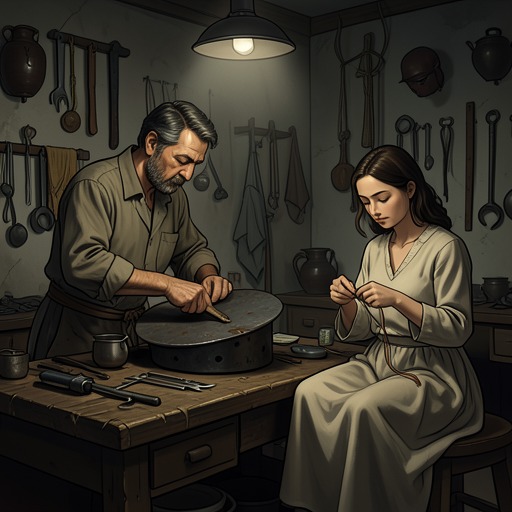
Louis Castaigne—Constance Hawberk
The King in YellowLouis Castaigne—Constance Hawberk is presented as a genuine romantic attachment that becomes an announced engagement and a practical promise of shared life. Their relationship is recognized by those around them, but its happiness is compressed by Louis Castaigne’s sudden military orders: the lovers must leave almost immediately for San Francisco, while the surrounding world is marked by violence, hunger, cold, and uncertainty.
Recognition and Social Context
The relationship first appears through the conversation between Hildred Castaigne and Mr. Wilde. When Mr. Wilde asks how Constance Hawberk and Louis Castaigne get along, Hildred answers simply that she loves him. The reply establishes Constance’s feeling as an accepted fact rather than a speculative attraction, while Mr. Wilde’s follow-up about Dr. John Archer places the romance within a broader field of rivalry and possible danger. The relationship is therefore not isolated from the plot’s conflicts: it is discussed alongside Hildred’s ambitions and the possibility that other personal disputes may be settled by force.
The lovers are also joined by the public identity and family setting represented by Hawberk’s shop. Louis, returning with his regiment from manoeuvres in Westchester County, rides past the shop in uniform. He is described as a handsome officer, and he turns to look directly at Hawberk’s establishment, flushing as he does so. Hildred infers that Constance may be watching from the window. The moment makes the relationship visible through gesture rather than declaration: Louis’s military display passes before the place associated with Constance, and his glance converts a public procession into a private act of recognition.
Courtship and Domestic Intimacy
After the regiment has passed, Louis Castaigne tells Hildred that he and his fellow officers had intended to drink a Brunswick cocktail, but that he had wanted an excuse to visit Hawberk instead. He invites Hildred to accompany him, making the visit sound spontaneous even though his real purpose is to see Constance. At the shop, old Hawberk says that he has just decided to take Constance for a stroll before dinner along the park terrace beside the North River. The exchange places the romance within ordinary courtship rituals: visiting the family, arranging a walk, and imagining a shared evening before dinner.
That domestic rhythm is important because it contrasts sharply with the military world surrounding Louis. His regiment, with its pale blue jackets, lances, pennons, sabres, and formal riding posture, gives him a ceremonial public presence; his wish to visit Hawberk instead reveals the private attachment beneath that performance. Constance is not shown making a grand speech or pursuing Louis through dramatic action. Her importance is conveyed through his change of intention, his glance toward the shop, and the family’s apparent acceptance of their companionship.
From Love to Marriage
The relationship reaches its clearest verbal confirmation when Louis tells Hildred that he has come to announce his marriage. He speaks of marrying the sweetest girl on earth, and Hildred immediately identifies her as Constance Hawberk. Louis is astonished that Hildred knows, explaining that he himself had not understood the decision until the evening in April when he and Constance walked down to the embankment before dinner. The recollection gives the romance a specific turning point: a seemingly simple walk becomes the occasion on which affection is recognized as a marriage commitment.
Louis’s happiness is described as open and almost exuberant. He smiles while announcing the marriage, accepts Hildred’s congratulations, and imagines himself as the happiest man alive. His language turns Constance’s presence into the measure of his future, while the planned title of Captain and Mrs. Louis Castaigne gives the relationship a public and institutional form. The romance is not merely an attachment hidden from society; it is moving toward marriage, shared travel, and a new household.
Military Interruption and Forced Departure
The intended wedding was originally scheduled for the following September, but an urgent despatch orders Louis Castaigne’s regiment to the Presidio in San Francisco. The regiment must leave at noon the next day. This order changes the relationship’s timetable from a gradual preparation for marriage to an immediate departure. Louis nevertheless presents the change as a cause for happiness rather than despair, because Constance will go with him. His insistence that she accompany him converts military displacement into a promised joint beginning, but it also shows how little control the couple retains over the conditions of their future.
The contrast between their private plans and the later atmosphere of siege is severe. In the Paris scenes elsewhere in the book, the air becomes painfully cold, the streets grow metallic and desolate, and the city is overwhelmed by sadness, hunger, and fear. The bombardment intensifies into rolling thunder; shells cross the sky, and crowds gather while waiting to learn whether a sortie is coming or whether starvation will continue. These circumstances do not directly narrate a new stage in Louis and Constance’s relationship, but they supply the surrounding emotional pressure against which the romance’s promised security must be measured. Love is announced in a world whose movements are governed by military orders and collective crisis.
Meaning and Dramatic Function
Louis Castaigne—Constance Hawberk embodies the possibility of ordinary happiness within a narrative increasingly organized by ambition, conflict, and destruction. The relationship begins in social observation and small acts of approach, becomes legible as mutual attachment, and then receives a formal future through marriage. Its decisive dramatic feature is the speed with which that future is threatened by circumstance: the lovers are ready to leave together, but the announcement is inseparable from the regiment’s relocation.
The relationship also sharpens the contrast between Louis and Hildred Castaigne. Louis’s attention is directed toward companionship, marriage, and the immediate happiness of taking Constance with him, whereas Hildred’s surrounding ambitions and conflicts give the same family world a more dangerous charge. Constance’s love is thus both a personal bond and a measure of the life Louis hopes to preserve. The romance’s brightness does not erase the book’s menace; instead, it makes the encroaching instability more legible, because the promised domestic future stands so clearly against military command, separation from familiar surroundings, and the wider spectacle of social collapse.